









Crusher Wear Parts: When to Replace Jaw Dies, Blow Bars and Cone Liners
Wear parts are one of the biggest running costs on a crusher. Change them too early and you throw away good manganese. Run them too long and a worn liner can turn into a damaged rotor, jaw stock or cone head. RTL Equipment supplies crusher wear parts for the EvoQuip, Powerscreen, MAGNA and Inertia crushers we sell and service, and this guide covers the signs that each type of liner is done.
Key Takeaways
- Jaw dies: replace the liner if any part of the face has less than 10 mm (about 3/8 inch) between tooth peak and valley.
- Blow bars: turn or replace them at the wear limit in your machine’s manual. Running past it can ruin the rotor.
- Cone liners: there is no universal safe thickness. Replace by the manufacturer’s limit, or sooner if output, product shape or power draw says the chamber has lost its profile.
- Keep a simple log of tons, hours and measurements for every liner set. It turns guesswork into a changeout forecast.
Why Timing Matters
Crusher liners are sacrificial. Their job is to wear so the expensive castings behind them don’t. Most jaw dies and cone liners are manganese steel, which work-hardens as rock pounds it. Terex’s wear parts guide notes that the hardened face is only about 2–3 mm deep at any time, while the core stays tough and ductile.
That’s why “run it until it’s gone” costs money. Once a liner wears past its limit, the backing surface takes the hits. A blow bar can come loose in the rotor. A jaw liner stops gripping rock. A cone liner can damage the head or bowl seating surfaces.
Lock it out before you measure. At surface mines and quarries, MSHA requires the power to be off and the machinery blocked against hazardous motion before repairs or maintenance (30 CFR 56.14105). That includes reaching into a crushing chamber to check wear.
Jaw Dies (Jaw Plates)
When to replace
- The 10 mm rule. Terex’s guide says every part of a jaw face must keep at least 10 mm (about 3/8 inch) between the peak and valley of the teeth. If any area has less, replace the liner.
- Flat faces overload the crusher. A smooth, worn face can’t grip rock, so it rubs instead of crushing. Terex warns that a smooth face results in high loadings.
- Flip or swap early. Most wear happens in the lower part of the jaw. Many jaw dies can be turned end for end to put fresh teeth in the crushing zone. Terex notes that rotating jaw liners early helps the faces work-harden more effectively.
- Don’t run to the backing. Once about 90% of the tooth profile is worn away, the jaw die is done. Change it before you’re crushing on the backing.
Measure the setting the right way
With the jaw at rest, you measure the open side setting (OSS). The manual gives the closed side setting (CSS). To find the CSS, subtract the machine’s stroke, listed in the technical information section of the manual, from the measured OSS. Never run tighter than the minimum CSS in the manual. A tight CSS also wears jaw dies faster.
Picking the right jaw die
| Manganese | Where it fits |
|---|---|
| 14% | Soft, low-abrasion rock. Usually a special order. |
| 18% | Standard on most jaw crushers. Suits all applications. |
| 22% | Work-hardens faster. A better choice for highly abrasive rock. |
Source: Terex EvoQuip Crusher Wear Parts Reference Guide. Availability varies by crusher model.
Tooth profile matters too. An S-tooth or “super tooth” profile grips medium-to-hard rock and recycled concrete. A multi-tooth profile grips smooth, flat material in recycling. A standard or shallow tooth suits recycling and soft rock.
Make jaw dies last longer
- Scalp out fines with the vibrating grizzly feeder so they bypass the jaw. Keep the grizzly opening no larger than the jaw’s CSS, so some smaller rock still helps the jaw grip.
- Run a larger CSS for the first day or two on new dies to help the faces work-harden.
- Keep wet, sticky fines out of the chamber as much as possible.
Impact Crusher Blow Bars
When to turn or replace
Every blow bar has a wear limit, shown in the operator’s manual for your machine. Most bars can be turned once to use the second face.
- Half worn: turn the bar.
- Fully worn on both faces: replace it.
- Past the limit: stop. Terex warns that a bar run past its limit may not sit stable once turned. It can loosen and fall out of the rotor, and the locking wedge can be knocked from its seat. In the worst case, the machine needs a new rotor.
Read the wear pattern
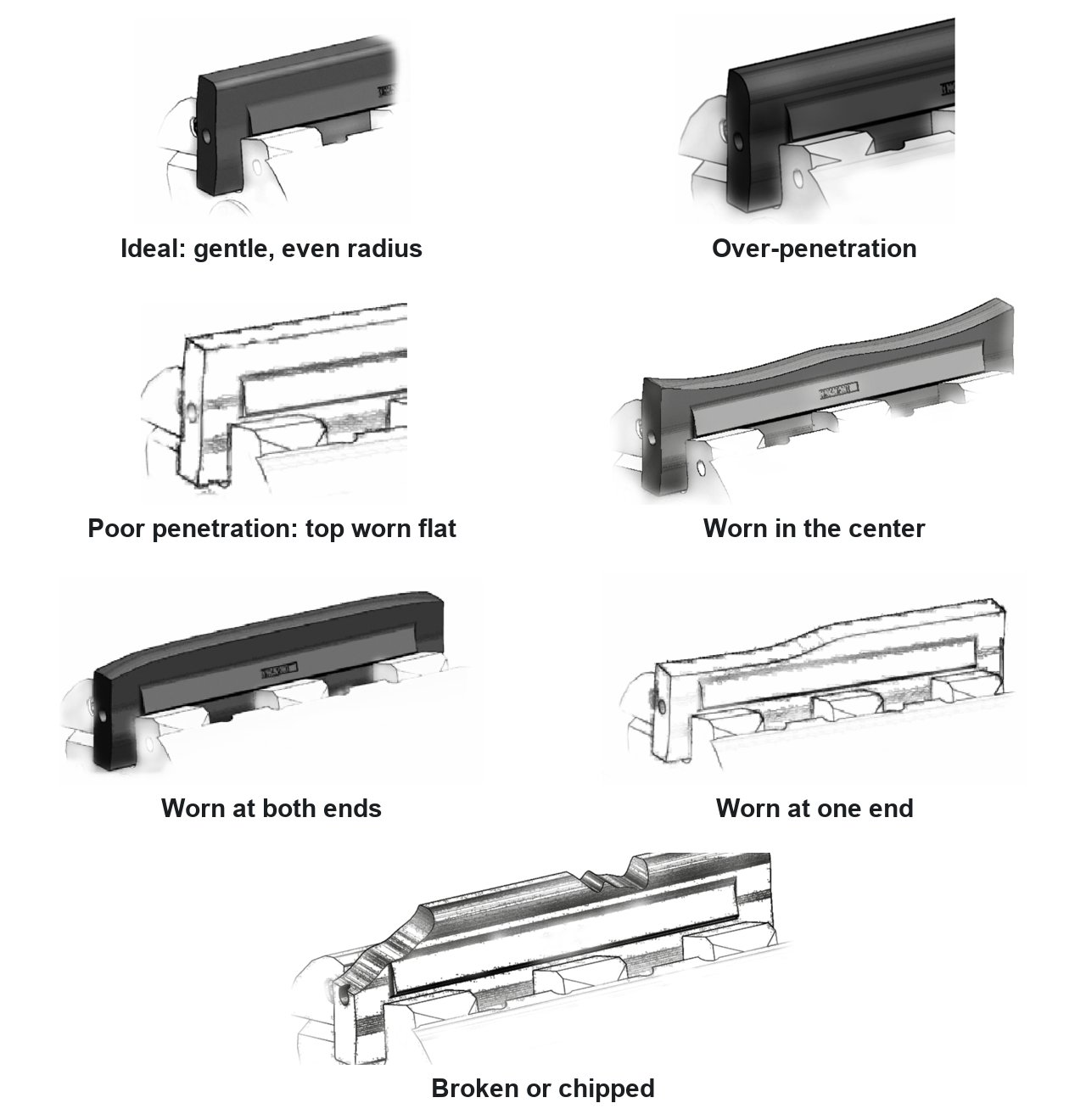
A worn blow bar tells you how the crusher is set up. Terex’s guide lists these patterns:
| What you see | Likely cause | Fix |
|---|---|---|
| A gentle, even radius | Feed size, rotor speed and bar choice are right | Keep doing what you’re doing |
| Deep scoop (over-penetration) | Rotor speed too slow; higher breakage risk | Raise rotor speed or run four high bars |
| Top worn flat (poor penetration) | Rotor speed too high; heavy wear and fines | Lower rotor speed or run two high and two low bars |
| Worn in the center | Trickle feed | Feed more steadily, for example with a larger loader or excavator, or speed up the feeder |
| Worn at both ends | Too many fines, overfeeding or caked material in the chamber | Slow the feeder and clean the chamber every shift |
| Worn at one end | Machine not level, not choke fed, or feed landing on one side | Level the machine and keep loading continuous |
| Broken or chipped | Wrong bar for the job, steel or rebar in feed, or feed too large | Change bar type, control feed size and pull out steel |
Choosing blow bar metallurgy
Harder bars resist wear but break more easily. Tougher bars take impact but wear faster.
| Bar type | Good for | Avoid with |
|---|---|---|
| Martensitic | Primary blasted rock, rubble and concrete, limestone, larger feed | Highly abrasive material |
| Martensitic ceramic | Asphalt, natural stone, rubble and concrete with medium abrasion | Very large feed, steel in feed |
| Chrome (medium or high) | Secondary crushing, smaller feed, abrasive rock like granite and basalt | Large feed, any steel |
| Chrome ceramic | Secondary natural stone; asphalt with small feed and no iron | Large feed, any steel |
| Toughened chrome | Rubble and concrete with limited steel | Large feed |
Source: Terex EvoQuip Crusher Wear Parts Reference Guide. Check your operator’s manual for the maximum feed size on your crusher.
Tips for a blow bar change
- Install bars in matched pairs by weight, on opposite sides of the rotor. Terex says paired bars should be within 0.5 kg (about 1.1 lb) of each other.
- Clean all mounting surfaces, the rotor backing bar and the locating key before fitting new bars.
- Dress any damage on the mounting area so the bars sit square in the rotor.
Cone Mantles and Concaves
There is no universal safe thickness for every cone. The right change point depends on the model, the chamber and your material. Watch for these signs:
- The OEM wear limit is reached. Replace by the model’s minimum thickness, wear dimension or adjustment limit. Don’t wait until the liner wears through.
- Throughput falls under comparable conditions. A worn chamber may no longer grip and process material well, even when the discharge setting is maintained.
- Product quality slips. More oversize, poorer shape or a higher recirculating load can point to a distorted chamber profile.
- More power or pressure for less output. Inspect the wear profile and check feed conditions. These symptoms can have several causes.
- Deep pockets or uneven wear. One area can reach its limit while plenty of manganese remains elsewhere. Average thickness can be misleading.
- Cracks, loose liners or exposed backing. Stop and inspect before running further. Continued running can damage the head or bowl seating surfaces.
Reduced capacity, distorted profiles and high power or pressure are all reasons liners may need replacing before their full wear life is used.
Change the mantle and concave as a set. Plan them as a matched replacement. Pairing a worn part with a new one can throw off the chamber profile and restrict production.
The Best Practical System: Keep a Liner Log
For any crusher, record the following for each liner set:
- Installation date and chamber profile
- Tons processed and hours run
- Adjustment position (CSS or apron setting)
- Throughput and product grading
- Wear measurements and photos, taken at the same locations each time during properly locked-out inspections
After two or three sets, you’ll have a reliable changeout forecast for that material and that crusher. Then you can order the next set before you need it instead of waiting on freight with the plant down.
Frequently Asked Questions
When should jaw crusher liners be replaced?
Replace a jaw liner when any part of its face has less than 10 mm (about 3/8 inch) between tooth peak and valley. A flat face can’t grip rock and overloads the crusher.
How do I know when to turn blow bars?
Turn blow bars when they reach the half-worn wear limit in your machine’s operator’s manual, and replace them when both faces are worn. Running past the limit can loosen the bar and damage the rotor.
When should cone crusher liners be changed?
Change them at the manufacturer’s wear limit, or earlier if throughput drops, product shape gets worse or power and pressure rise for less output. Replace the mantle and concave together.
What’s the difference between 18% and 22% manganese jaw dies?
Both are manganese steel. 18% is the standard fit for most applications. 22% work-hardens faster and is the better choice for highly abrasive rock.
Which blow bars are best for concrete with rebar?
Martensitic or toughened chrome bars handle some steel in the feed. Chrome and chrome ceramic bars are harder but can break if steel gets into the chamber.
Get Crusher Wear Parts From RTL
RTL stocks wear parts for the EvoQuip, Powerscreen, MAGNA and Inertia crushers we sell and service, including Powerscreen and EvoQuip blow bars. Running another brand of impactor? Ask us about Wearkraft, Terex’s wear parts line for other crusher makes. Send us your crusher model, serial number and what you’re crushing, and we’ll match the right liners. Send a parts request or call the branch nearest you.
- Cedar Rapids area (Swisher, IA)
319.391.5471 - Des Moines area (Grimes, IA)
515.986.0262 - Big Lake, MN
763.220.6528 - Omaha area (Crescent, IA)
402.534.1234
Sources
- Terex, EvoQuip Crusher Wear Parts Reference Guide (jaw wear limits, setting measurement, manganese grades, blow bar wear limits, wear patterns and selection). Figures checked against the 2024 edition.
- MSHA, 30 CFR 56.14105, Procedures during repairs or maintenance.
- C&D Recycler, Terex launches Wearkraft (wear parts for other crusher brands).